The Dog Beneath the Tar: How Solar Was Freed From a Hardened Asphalt Trap
We Love Kittens!
Last update : few days ago
25 Minutes to read
When rescuers first spotted the small dog near a thick patch of bushes, it was difficult to understand what they were seeing.

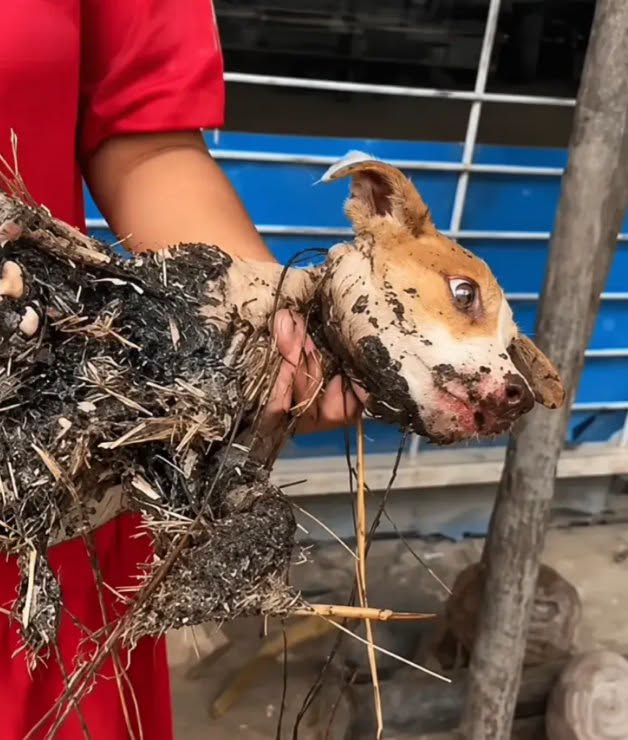
The little animal was almost indistinguishable from the black asphalt surrounding him. His fur, legs, paws, and much of his face were covered in a thick, sticky substance. Dry grass, twigs, leaves, and other bits of debris had become trapped in the coating, creating a heavy shell around his small body.
He could barely move.
What initially might have looked like an ordinary case of a dog becoming stuck in mud was far more serious. The material covering him was asphalt, and it was gradually hardening around his body. With every passing moment, the substance threatened to restrict him further.
The dog was later given the name Solar.
By the time rescuers reached him, Solar was already exhausted. His legs were weighed down, his movements were severely limited, and the hardened material pulled tightly against his coat and skin. He could not simply get up and walk away.

He needed help—but freeing him would have to be done with great care.
The rescuers understood that the rescue itself could cause additional injury if they rushed. Pulling hardened asphalt directly from his fur could tear his coat and hurt the sensitive skin underneath. Trying to force the material away could leave him with painful wounds.
Solar needed patience more than strength.
The first priority was to remove him from the dangerous area. Once he was safely away from the asphalt, the rescuers could begin the much longer process of freeing his body from the material that had trapped him.
Removing the Asphalt One Layer at a Time
Getting Solar out of immediate danger was only the beginning.
The thick black coating remained firmly attached to his fur and body. Ordinary water was not enough to dissolve or remove it. At the same time, harsh chemical solvents could create additional dangers for a small, exhausted animal, especially when the material was covering such a large portion of his body.
Instead, the rescuers used vegetable oil to soften the asphalt.
They applied the oil generously to the hardened coating and gave it time to work. Rather than trying to tear the asphalt away, they allowed it to loosen gradually.
It was slow work.
Little by little, the sticky material began to separate from Solar’s fur. The rescuers worked through his coat by hand, carefully breaking apart pieces of asphalt and removing the debris that had become embedded in it. Fine-tooth combs helped them work through areas where grass, twigs, and other particles had become tangled with the hardened coating.
Every section required attention.
A sudden pull could hurt Solar, so the rescuers had to work gently. They could not simply cut away large sections without considering what might be underneath. They had to distinguish between the material that could be safely removed and the fur and skin that needed to remain protected.
Solar’s condition made the process even more difficult.
He was frightened and exhausted, yet he remained remarkably still while the rescuers worked. For hours, they continued the painstaking process of loosening the asphalt and freeing his body piece by piece.
There was no shortcut.
The rescue depended on repeating the same careful actions over and over: apply oil, wait for the asphalt to soften, loosen the material, remove the debris, comb through the fur, and repeat the process.
As the black coating gradually disappeared, more of Solar’s body became visible.
Underneath the asphalt was a small dog with a light-colored coat and soft brown patches. The contrast was striking. The animal who had first appeared almost completely black was slowly returning to his natural appearance.
But even after the thickest portions of asphalt had been removed, the work was not finished.
Oil and residue remained throughout his coat, along with traces of the sticky material. The rescuers needed to clean him thoroughly, which meant multiple baths using degreasing dish soap.
The bathing process required just as much patience as the initial removal.
Solar’s coat had been saturated with oil and contaminated with residue. Each round of washing removed more of the remaining material, but it could not all be eliminated at once. The rescuers repeatedly scrubbed and rinsed him, continuing until the asphalt and oil had been reduced as much as possible.

The entire process took hours.
For Solar, those hours represented more than a cleaning session. They were the hours that separated him from the condition in which rescuers had found him.
Eventually, the dark coating was gone.
The small dog could move again.
A Different Dog Emerges
Once Solar had been freed from the asphalt, attention turned to another important question: what had the exposure done to his body?
Being trapped in asphalt was not simply uncomfortable. Prolonged contact with a hazardous substance could cause injuries, particularly to the skin. There was also concern about whether Solar might have swallowed enough of the material to cause serious internal harm.
Veterinary checks provided some relief.
Solar had not consumed a lethal amount of the hazardous material. His skin had become irritated after being in prolonged contact with the asphalt, but it remained intact. Most importantly, the material that had physically trapped him had been removed.
Now he had a chance to recover.
His physical transformation was obvious, but an equally important change began to appear in his behavior.
When rescuers first encountered Solar, he could barely move. His body was weighed down by hardened material, and even simple movement was difficult. After the asphalt was removed, he could finally walk freely.
He began exploring.
His tail started wagging.
He could move around the shelter instead of remaining almost completely still. He could go outside and walk across the courtyard. He could interact with other rescued dogs and investigate the unfamiliar surroundings around him.
These might sound like ordinary activities, but for Solar they represented something extraordinary.
Only a short time earlier, his legs had been trapped. Now he could use them.
Only a short time earlier, his body had been hidden beneath a thick black shell. Now he could move through the sunshine with his natural coat visible.
Only a short time earlier, he had depended entirely on rescuers to change his circumstances. Now he could begin behaving like an ordinary dog again.
His recovery was not a single dramatic event.
There was no instant in which everything suddenly returned to normal. Instead, Solar’s transformation happened through a series of small victories.
First, he was removed from the dangerous area.
Then the rescuers softened the asphalt.
They removed it piece by piece.
They carefully worked through his fur and removed the grass and debris trapped inside the coating.
They washed away the oil and remaining residue.
Veterinarians checked his condition.
And finally, Solar was given a safe environment in which he could rest, recover, and gradually regain confidence.
Each step mattered.
The Importance of Patience
Solar’s rescue is a reminder of how dangerous discarded materials can become for animals living outdoors.
A person who encounters industrial waste or a puddle of asphalt may understand that it is something to avoid. A stray animal does not necessarily have that understanding.
Dogs searching for food or shelter may investigate unfamiliar substances without knowing the danger they contain. What appears to be an ordinary patch of wet ground or an unusual puddle can become a trap.
For Solar, that is exactly what happened.
Once his body became coated in the sticky material, escaping became increasingly difficult. As the asphalt hardened, his ability to move was reduced. The more he struggled, the greater the possibility that he could hurt himself.
Eventually, he was left in a situation from which he could not free himself.
By the time rescuers found him, the asphalt had already become a heavy shell around his body.
His rescue therefore required more than simply finding him.
Someone had to recognize the danger.
Someone had to approach him carefully.
Someone had to get him away from the contaminated area.
And then someone had to spend hours removing the material without causing additional injury.
The rescuers could not force the process.
They had to wait for the oil to soften the asphalt. They had to work slowly through the fur. They had to remove debris piece by piece. They had to bathe him repeatedly.
The process may have looked tedious, but every careful action served a purpose.
Solar’s stillness during the rescue was also remarkable. Although he was frightened and exhausted, he allowed the rescuers to handle him for hours. His ability to tolerate the process gave them the opportunity to work carefully and avoid unnecessary injury.
Eventually, the heavy black shell that had covered him was gone.
What remained was not an animal defined by the accident that had nearly trapped him, but a small dog with the ability to recover.
His appearance changed first.
Then his movement.
Then his behavior.
As his discomfort eased, Solar became more curious about the world around him. He explored his surroundings. He walked through the courtyard. He wagged his tail. He interacted with other dogs.
The ordinary things that most people might overlook suddenly carried a different meaning.
A dog walking freely across a courtyard is not usually remarkable.
For Solar, it was evidence of how far he had come.
From Trapped to Free
Perhaps the most powerful part of Solar’s story is not the shocking appearance of a dog covered in asphalt.
It is what happened afterward.
The black material had almost completely hidden him. It covered his fur and restricted his legs so thoroughly that it was difficult to imagine the small dog underneath. Yet the rescuers never treated his condition as hopeless.
They saw an animal who could still be helped.
Instead of trying to solve the problem as quickly as possible, they focused on solving it safely.
That distinction mattered.
There are emergencies in which speed is essential. Solar’s situation required something different. The danger was immediate, but the solution had to be gradual.
Every piece of asphalt that came away made his body lighter.
Every strand of fur that was freed gave him more movement.
Every bath removed another layer of residue.
Every careful step brought him closer to recovery.
Eventually, Solar was no longer the nearly immobile animal the rescuers had first encountered.
He was simply a dog again.
A dog who could walk.
A dog who could explore.
A dog who could wag his tail.
A dog who could spend time outdoors in the sunshine.
And, perhaps most importantly, a dog who could begin trusting the people who had refused to give up on him.
Solar’s experience also demonstrates how quickly an animal’s circumstances can change when the right help arrives. Before the rescue, his world had been reduced to the immediate struggle of trying to move while his body hardened inside a layer of asphalt.
Afterward, that world expanded again.
There were people around him.
There was shelter.
There was food and care.
There were other dogs.
There was open space to explore.
There was sunshine.
Simple freedoms had returned.
His recovery did not erase what happened to him, but it changed the ending of the story.
The asphalt had nearly immobilized him, but it did not define him.
The material had covered his body, but it could not erase the dog underneath.
And the people who rescued him did not need a dramatic miracle to save him. They needed knowledge, care, determination, and an enormous amount of patience.
A Second Chance
Solar’s story ultimately becomes a story about what can happen when people are willing to stay with a difficult rescue until the job is done.

When rescuers first found him, the task must have seemed overwhelming. The asphalt was hardened across much of his body, debris was tangled in his coat, and the animal beneath it was exhausted.
There was no quick solution.
But the rescuers continued.
They softened the material.
They removed it carefully.
They washed him again and again.
They checked his health.
They watched him recover.
And eventually, Solar began to show the signs of the dog he had always been.
His story is a reminder that recovery does not always happen in one dramatic moment. Sometimes it happens gradually, through dozens of small acts of care that may seem insignificant on their own.
One piece of asphalt removed.
One patch of fur cleaned.
One bath completed.
One step taken.
One tail wag.
One moment of curiosity.
Together, those moments can become a transformation.
Solar began his rescue almost completely trapped beneath a hardened black coating. He ended it with the freedom to walk through a sunny courtyard and explore the world around him.
That difference is what makes his story so moving.
Beneath the asphalt was a small dog who still wanted to live, move, explore, and trust.
The rescuers simply gave him the chance.
Layer by layer, they removed what had trapped him.
And with every layer that disappeared, Solar came back into view—not only physically, but as the lively little dog he had been all along.
His rescue is ultimately not a story about asphalt.
It is a story about patience.
It is about recognizing that a frightened animal can still have a future, even when its condition looks overwhelming.
It is about choosing careful compassion when force would be easier.
And it is about understanding that sometimes the most important rescue work happens slowly.
For Solar, that patience restored something the asphalt had taken away: movement.
And with movement came freedom.
With freedom came curiosity.
With curiosity came trust.
And with trust came the possibility of an ordinary life.
After everything he had endured, Solar could finally do something that should never have been taken from him in the first place.
He could simply be a dog again.
Chester’s Journey: From Cage to Compassion, His Legacy Inspires Fight Against Animal Cruelty
Chester’s story is one that lingers long after it is told—a quiet but powerful reminder of both the depths of suffering animals can endure and the extraordinary compassion that can still meet them, even if only for a short time. It is not an easy story to hear, but it is an important one, because it reflects a reality that too often goes unseen.

About the Author