
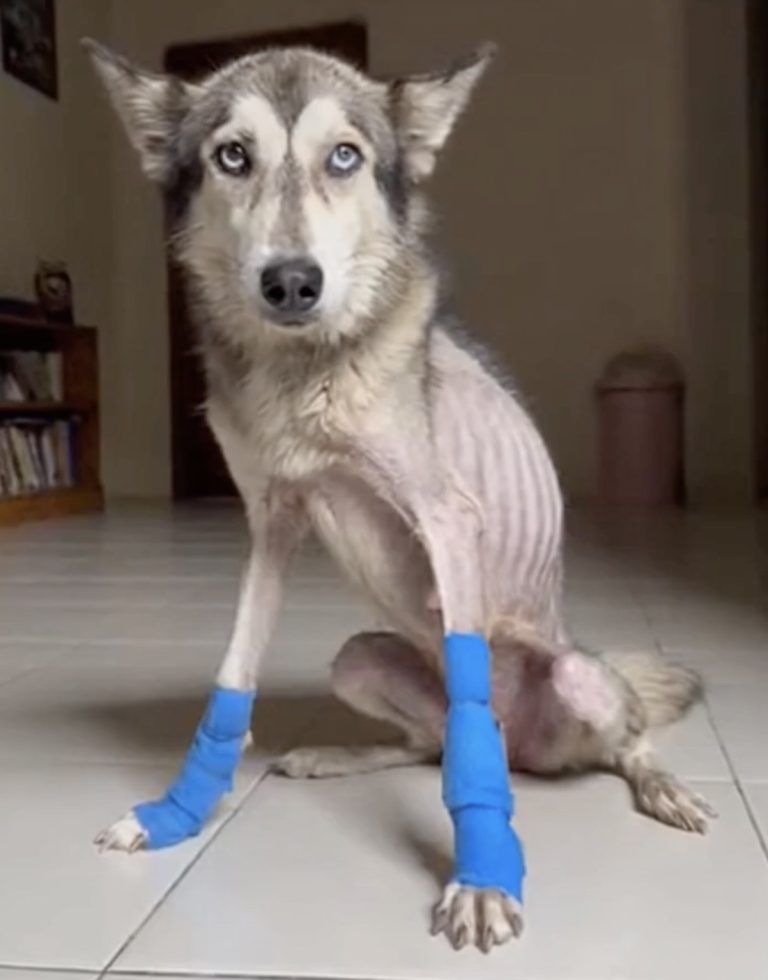
Russell’s story is one of those moments that stops you in your tracks and forces you to confront both the cruelty and the compassion that exist in this world. He was not lost or wandering when tragedy struck him. He had an owner, someone he trusted, someone he depended on. In an unthinkable act, that very person threw him from a speeding car and drove away, leaving him broken on the side of the road as if his life meant nothing.
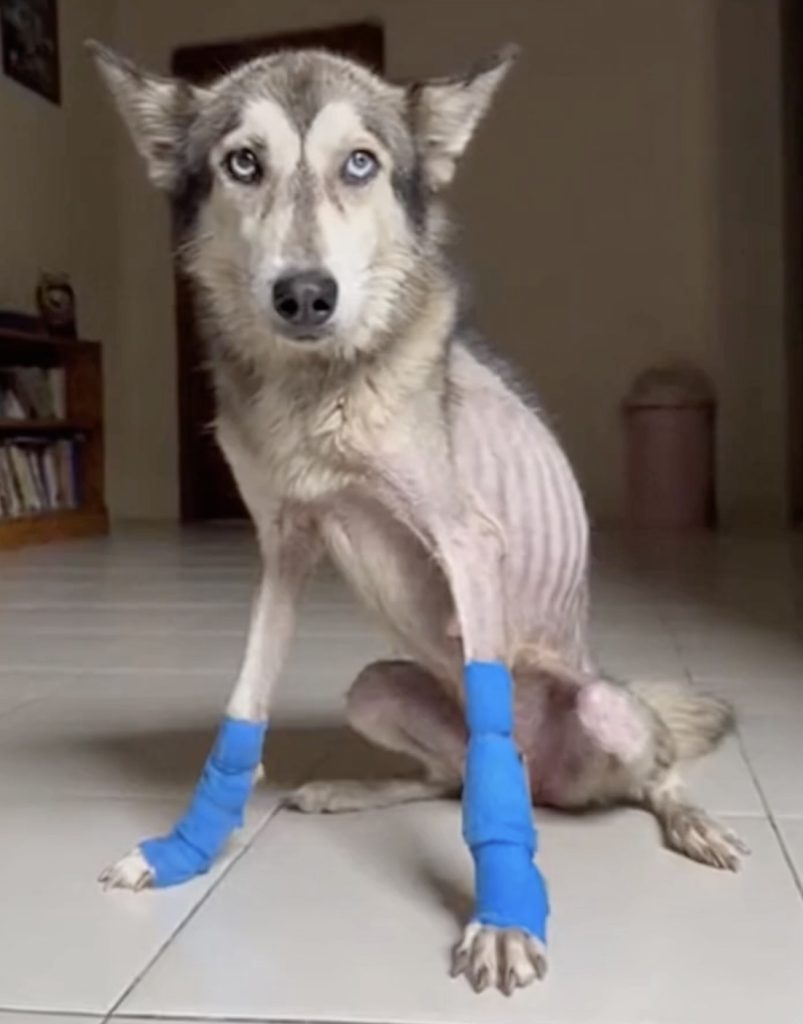
When rescuers found Russell, he was lying motionless near the pavement, his body battered and his spirit shaken. He could not move his back legs. Every attempt to lift his head seemed to cost him what little strength he had left. A veterinary examination revealed devastating news: his spine was broken. The odds of him ever walking again were painfully slim. For many animals in that condition, the story would have ended there.
But Russell’s life did not end on that roadside.
A small group of determined rescuers chose to see more than a prognosis. They saw a living soul who deserved a second chance. They refused to define him by a single medical report. Instead of turning away from the staggering cost and emotional toll, they committed themselves to giving him every possible opportunity to heal.
The first surgery was an attempt to stabilize the damage to his spine. It was complex and risky, and the hours in the waiting room felt endless. When it was over, hope flickered—but only briefly. Russell showed little improvement. His back legs remained unresponsive, and complications threatened to undo the fragile progress he had made. The second surgery followed, another effort to correct what had gone wrong and give him a fighting chance.
When that procedure failed to produce the breakthrough everyone prayed for, the weight of disappointment was crushing. The rescuers were exhausted. Their savings were dwindling. Emotionally and financially, they were stretched beyond what most people would consider reasonable. Yet even in their despair, they could not imagine walking away from Russell the way he had once been abandoned.
Instead, they made a decision that would change everything.
They gathered every dollar they had left and committed to a third surgery. It was not a choice made lightly. It was born out of love, faith, and the belief that Russell deserved every effort. The risks were high, and there were no guarantees. But they could not live with themselves if they did not try one more time.
This time, something remarkable happened.
In the days following the procedure, subtle signs began to emerge. A slight twitch in one paw. A faint response when his toes were gently stimulated. For most people, those movements might have seemed insignificant. For Russell’s caregivers, they were nothing short of a miracle. After weeks of uncertainty, there was finally a spark of hope grounded in real progress.
Recovery did not happen overnight. Healing from a spinal injury is slow, demanding, and often frustrating. Russell began an intensive course of physical therapy designed to strengthen his muscles and retrain his nervous system. Each session required patience. He had to learn, inch by inch, how to bear weight again. Some days brought small victories; others tested everyone’s resolve.
Through it all, Russell was never alone.
He was surrounded by a new family who saw him not as a burden, but as a blessing. They supported his body with harnesses and gentle hands. They celebrated every tiny gain, whether it was holding himself upright for a few extra seconds or pushing his wheelchair forward with growing confidence. Their home became a place of encouragement, where setbacks were met with compassion instead of frustration.
For now, Russell relies on a specially designed wheelchair to move through the world. It allows him to explore the yard, feel the sun on his face, and experience life with a sense of independence. Watching him glide across the grass, tail wagging, it is hard to reconcile that image with the broken dog once left by the roadside.
His wheelchair is not a symbol of defeat. It is a bridge—proof that mobility, joy, and dignity are still possible, even after profound injury. It represents the resilience of a body that refused to give up and the devotion of people who refused to let him fade away.
What makes Russell’s journey so powerful is not just the medical turnaround. It is the unwavering commitment that carried him through three surgeries, countless therapy sessions, and moments of deep uncertainty. It is the reminder that healing is rarely linear. Progress can be measured in the smallest of movements, in the quiet determination to try again tomorrow.
Today, Russell can move his legs with more strength than anyone initially believed possible. He continues to build muscle, to respond to therapy, and to surprise those who once feared he would never stand again. The road ahead remains long, but it is no longer defined by hopelessness.
There is now a solemn promise that guides his caregivers forward: with continued care, steady rehabilitation, and the same unwavering love that brought him this far, Russell will one day walk on his own. That promise is not built on fantasy. It rests on the evidence of his progress and the unbreakable bond between a dog and the people who chose to fight for him.
Russell’s story speaks to something deeper than recovery. It speaks to accountability, compassion, and the extraordinary difference a committed heart can make. For those who have loved a pet, who understand the quiet loyalty in a dog’s eyes, his journey resonates on a profoundly personal level.
He was discarded once. He was written off as beyond hope. And yet, through persistence and grace, he stands—literally and figuratively—as a testament to resilience. His life is proof that even after betrayal and devastating injury, a second chapter can begin. And sometimes, that second chapter is stronger, kinder, and more inspiring than the first.
