
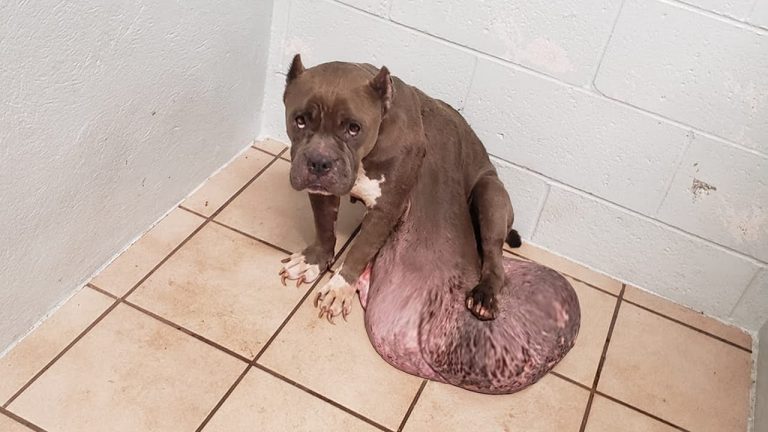
Magnolia’s story is one of those rare journeys that reminds us how fragile life can be—and how powerful compassion truly is. Abandoned and left to endure unimaginable discomfort on her own, she carried a massive tumor that had grown so large it changed the way she moved, the way she rested, and even the way she saw the world. Yet beneath that physical burden was a gentle soul still capable of trust.
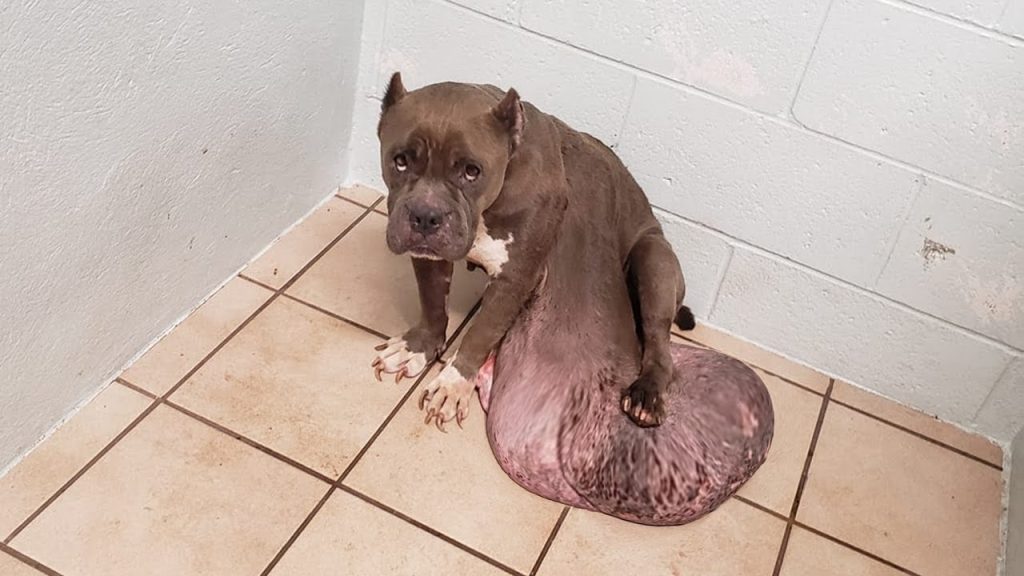
Her rescue led to an urgent and high-stakes medical decision. Veterinarians quickly realized they were facing one of the most challenging cases of their careers. The tumor was described as the largest they had ever encountered. It was not only enormous but also dangerously complex, fed by an extensive network of blood vessels. Magnolia herself was underweight, which made the situation even more delicate. She did not have extra strength to spare, and any miscalculation could put her life at risk.
The surgical team prepared with extraordinary care. Removing a tumor of that size required patience measured in hours, not minutes. Every vessel had to be carefully tied off to prevent excessive blood loss. Throughout the procedure, her vital signs were monitored constantly. The room carried the quiet intensity that comes when everyone understands what is at stake. Magnolia’s life depended on precision, teamwork, and hope.
Despite the risks, the surgery was successful. The tumor that had weighed her down—physically and emotionally—was finally gone. What remained was a fragile dog beginning a new chapter. In the immediate aftermath, the medical team focused on stabilizing her. Because she had been undernourished, she was given high-calorie supplements designed to gently rebuild her strength. Her body had endured so much, and now it needed fuel to heal.
What happened next surprised everyone. That very evening, Magnolia was sitting up on her own. Her eyes were alert. She showed interest in food, a simple but powerful sign that her spirit was intact. For anyone who has ever cared for a sick animal, that first spark of appetite feels like a small miracle. It means the will to live is still there.
By the next morning, Magnolia was walking independently. She appeared slightly confused, as if trying to understand what had changed. The heavy mass she had carried for so long was suddenly gone. She was lighter by fifteen pounds, and her body seemed to be rediscovering balance. There was a hint of excitement in her movements—an almost childlike curiosity—as she adjusted to her new reality.
In just a few days, the transformation became undeniable. Within five days, Magnolia evolved into what her caregivers lovingly described as a “lap dog.” She sought out closeness. She leaned into gentle hands. She rested her head against knees and chests, as if making up for lost time. The dog who once struggled under a crushing weight now moved freely, exploring the outdoors without pain dragging at her every step.
For an audience who has lived long enough to witness both heartbreak and redemption, Magnolia’s recovery carries a deeper resonance. It is not merely a medical success story. It is a testament to resilience. Many of us understand what it means to carry burdens—whether physical, emotional, or invisible to others. Watching Magnolia shed hers so dramatically reminds us that relief, though sometimes delayed, is possible.
Her foster home became the setting for yet another turning point. No longer defined by illness, Magnolia was healthy, affectionate, and eager for connection. She greeted her first visitors with curiosity and warmth. The home that once served as a place of recovery now felt like a launching point for a brighter future. She was no longer a patient; she was a companion waiting to belong.
The beauty of Magnolia’s journey lies in its simplicity. She did not ask for grand gestures. She needed skilled medical care, proper nutrition, and above all, human kindness. In return, she offered loyalty, affection, and a reminder of how quickly love can bloom once pain is removed.
For those who care deeply about animal welfare, her story also highlights the importance of timely intervention. Large tumors do not appear overnight. Abandonment often allows medical conditions to worsen unchecked. Magnolia’s case underscores why rescue organizations, foster families, and dedicated veterinarians play such a critical role. Their commitment transforms what might have been a tragic ending into a hopeful beginning.
Today, Magnolia stands as living proof that second chances matter. The fifteen pounds that once held her back are gone, replaced by confidence and comfort. The dog who once endured silent suffering now curls happily into laps, steps confidently into open air, and welcomes visitors with gentle enthusiasm.
Her journey does not erase what she endured, but it redefines her future. Somewhere ahead is a forever family—one that will see not the shadow of her past but the light of her resilience. They will see a dog who overcame tremendous odds, who trusts again despite being abandoned, and who greets each day with renewed joy.
Magnolia’s transformation reminds us that healing is rarely instant, often risky, and always worth the effort. It requires courage from medical professionals, patience from caregivers, and remarkable strength from the one who is healing. In her quiet way, Magnolia demonstrated all three.
For anyone watching her story unfold, the takeaway is clear: compassion changes outcomes. When we choose not to look away from suffering, when we invest time and care into those who cannot speak for themselves, we become part of a miracle in motion.
Magnolia is no longer defined by the tumor that once overshadowed her life. She is defined by recovery, by affection, and by the simple joy of being able to move freely again. And as she waits for the family who will love her for the rest of her days, she carries something far more powerful than the weight she lost—she carries hope.
