
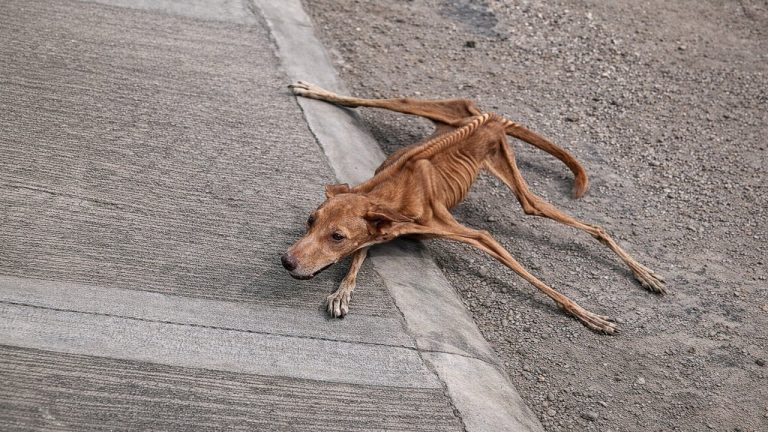
Blair’s story begins in a place no living creature should ever have to endure—alone, exhausted, and slowly fading from the inside out. When she was first discovered, her body told the story of prolonged starvation. Her back was severely hunched, not from injury, but from weeks of deprivation that had drained every ounce of strength from her fragile frame. Each rib was visible beneath thinning fur. Every movement required effort she no longer had.
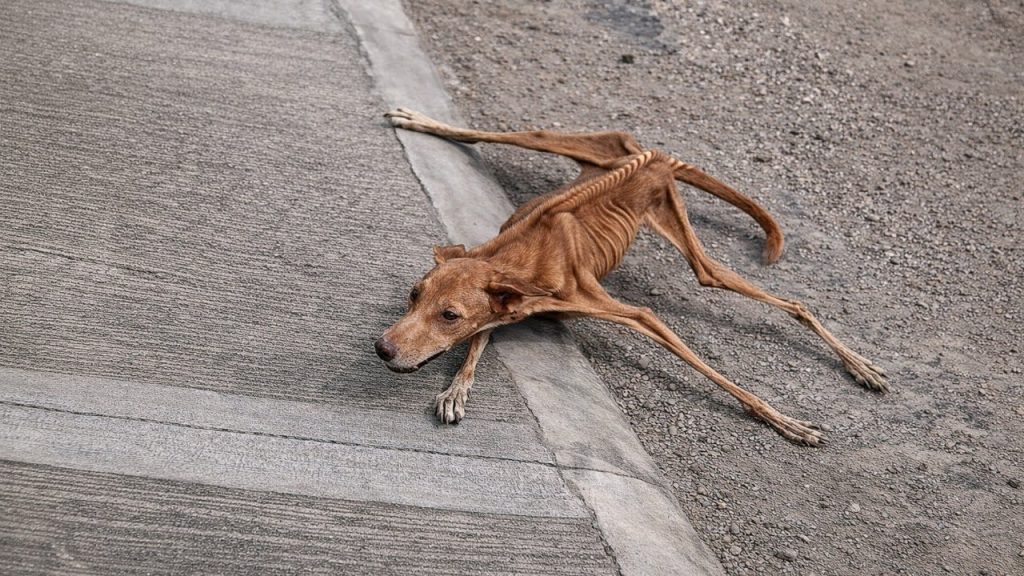
She tried to walk, but even that simple act had become a struggle. With trembling legs and shallow breaths, Blair stumbled forward, step by unsteady step, toward a bowl of food placed just a few feet away. It should have been easy. Instead, it looked like climbing a mountain. Hunger overpowered her fear of people, though her eyes still reflected uncertainty. She wanted to trust, but survival had taught her caution.
The woman who found her moved slowly, speaking softly, understanding that Blair’s spirit was as wounded as her body. Despite her fear, Blair accepted help. Hunger left her no choice. That quiet decision—allowing someone close—became the first step in a journey that would redefine her life.
At the veterinary clinic, the medical team worked quickly. Tests confirmed what her appearance already suggested: she was dangerously dehydrated and severely malnourished. Her body had been running on empty for far too long. Yet, amid the gravity of her condition, there was a small but powerful piece of good news. Her spine, though painfully curved from muscle loss and weakness, had not suffered permanent structural damage. What looked hopeless was, in fact, something that could heal with time and care.
A strict, high-nutrient feeding plan was put into place immediately. Her meals were carefully portioned to avoid overwhelming her system. Medication addressed underlying deficiencies and supported her recovery. Day by day, her body began to respond. The first changes were subtle—a slightly steadier stance, a deeper breath, a longer stretch of restful sleep.
Within just a few days, something remarkable began to happen. As Blair regained muscle mass and essential nutrients, her spine slowly started returning to its natural alignment. The pronounced hunch that once defined her silhouette softened. Strength replaced frailty. Her steps grew firmer. She no longer collapsed after a few paces. Each improvement, however small, carried enormous meaning.
Recovery is rarely dramatic in the moment. It unfolds quietly, in ordinary acts repeated consistently—meals prepared with care, medications given on schedule, gentle reassurance offered again and again. For Blair, healing was not just physical. Trust had to be rebuilt. The same hands that delivered food also offered patience. The same voice that soothed her during treatment remained steady and kind.
Weeks passed, and the transformation became undeniable. The dog who once trembled in exhaustion began to explore her surroundings with cautious curiosity. Her eyes, once dull with fatigue, brightened. She started to wag her tail—tentatively at first, then with growing confidence. Playfulness emerged where fear once lived.
Eventually, Blair moved into her rescuer’s home. What began as an act of emergency compassion grew into something deeper. In that home, she discovered stability. Soft bedding replaced cold ground. Regular meals replaced hunger. Gentle affection replaced isolation. The trembling, broken animal who had struggled to reach a bowl of food evolved into a vibrant companion who followed her new owner from room to room.
The bond between them did not form overnight. It was built through consistency, through countless small moments—quiet evenings, patient encouragement, shared routines. Blair learned that human hands could offer safety instead of harm. Her rescuer learned that resilience can live even in the most fragile body.
Today, Blair moves with strength and confidence. Her back stands naturally aligned, no longer burdened by the visible curve of starvation. Her gait is steady. Her spirit, once weighed down by survival, now reflects joy. She plays. She rests peacefully. She greets her owner with enthusiasm that speaks louder than words ever could.
Her journey is a reminder of something many of us understand deeply: love, when paired with proper care, has the power to restore what seems lost. Nutrition, medical attention, and patience created the foundation. Compassion completed the work. What once appeared to be a life on the brink of tragedy became a living testament to resilience.
Blair’s recovery did not erase what she endured. But it proved that suffering does not have to be the final chapter. With timely intervention, informed medical support, and unwavering kindness, even the most fragile life can find its way back.
For those who have opened their homes and hearts to animals in need, her story feels familiar. For those considering it, her transformation offers hope. Behind every trembling body may be a spirit waiting for a second chance.
Blair’s story is not simply about survival. It is about restoration. It is about the quiet power of showing up, day after day, for a being who cannot repay you in words—but will return your care in loyalty, trust, and unconditional love.
In the end, what saved Blair was not one dramatic moment. It was steady compassion, guided by knowledge and fueled by heart. And sometimes, that is exactly what it takes to bring a life back from the edge.
