
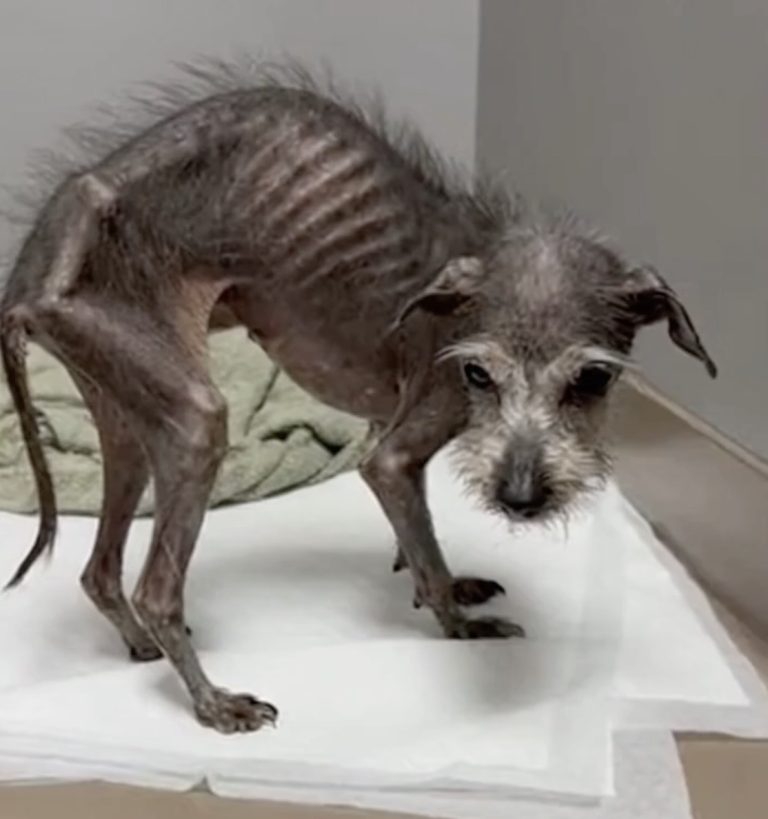
Angela’s story is one that lingers in the heart long after you hear it. For nearly ten years, she existed in conditions no living creature should ever endure, confined to a cramped, lightless cage that denied her even the smallest comforts of life. Hidden away from the world, she survived in silence, her days marked not by kindness or companionship but by neglect and suffering. It was only when the property where she had been kept was finally sold that her existence came to light, revealing a reality almost too painful to comprehend.
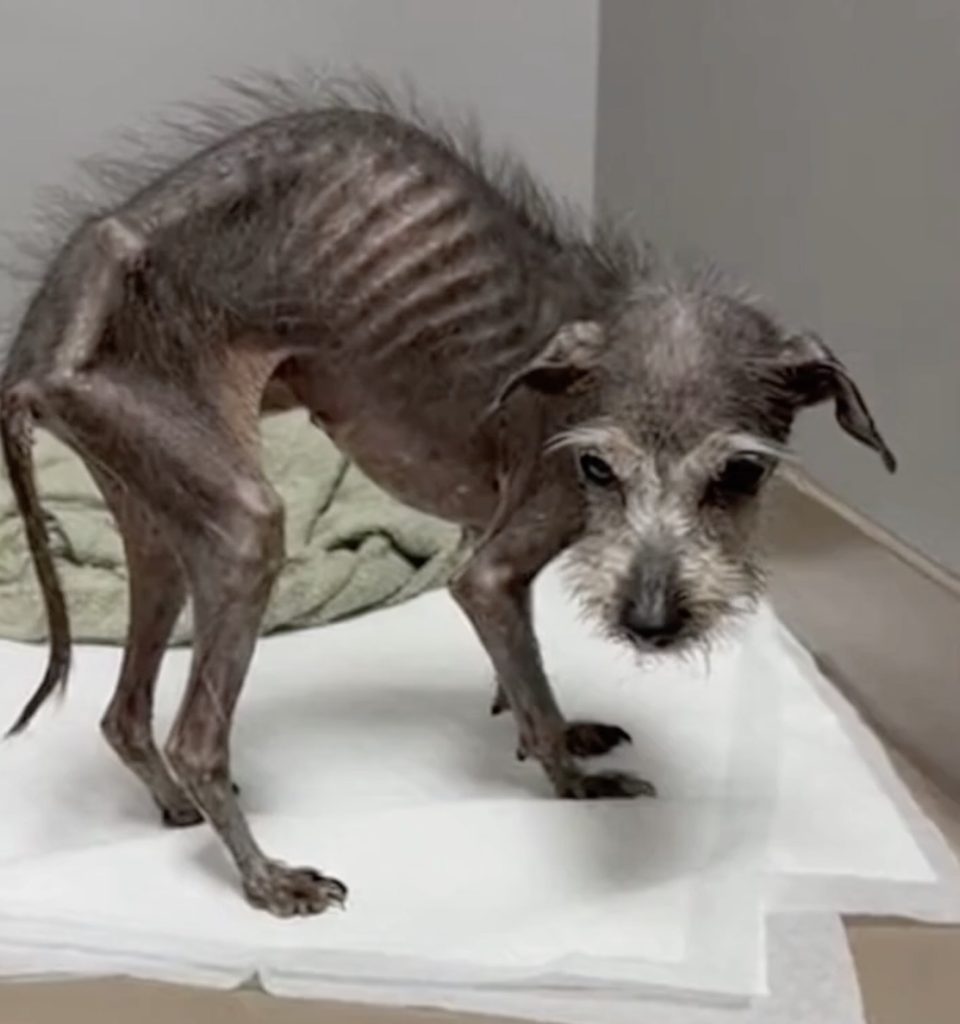
The new owners were unprepared for what they found. Inside that dark enclosure was a frail, malnourished dog whose body bore the visible marks of long-term mistreatment. Her fur was thin and patchy, her skin inflamed and wounded, and a heavy chain restrained her so tightly that escape had never been an option. Years of isolation had taken more than a physical toll. Angela’s eyes reflected a deep, instinctive fear of everything around her. Every sound, every movement, seemed to confirm the world as a place of danger rather than safety.
When rescuers brought her into the light for the first time in nearly a decade, it was clear she was in critical condition. At the veterinary clinic, the medical team quickly discovered the extent of her suffering. Severe skin infections had spread across her fragile body, causing constant discomfort. Even more alarming was a life-threatening uterine infection known as pyometra, a condition that can become fatal without prompt intervention. Her weakened state made immediate surgery too risky. Her body simply did not have the strength to endure such a procedure.
The veterinary team faced a delicate challenge. Before they could address the infection surgically, they had to stabilize her. Angela was placed on a strict treatment plan that included specialized skin therapies to soothe and heal her damaged coat. She was kept warm and carefully monitored, wrapped in blankets that offered a comfort she had likely never known. Because her liver function showed signs of stress from years of neglect, she was placed on a controlled diet designed to support and rebuild her internal health. Every small detail mattered.
Despite everything she had endured, Angela showed a quiet determination that inspired everyone around her. In the beginning, she was too weak to do much more than lie still. Her head barely lifted from the bedding, and even the effort to swallow seemed exhausting. Yet within a few days of receiving proper nourishment and care, something began to shift. She started eating on her own, a small but powerful sign that her body was responding. With each meal, her strength slowly returned.
It was not an instant transformation. Healing from nearly a decade of confinement and neglect does not happen overnight. But progress, however gradual, became visible. Angela managed to sit up without assistance, her posture unsteady yet undeniably stronger than before. The staff celebrated these moments quietly, understanding that what might seem minor to an outsider represented enormous victories for a dog who had once been too weak to move. Each day she held herself upright was a testament to resilience.
Perhaps the most remarkable turning point came just days after her rescue. This was the same dog who had once been unable to lift her head, whose body trembled under the weight of infection and exhaustion. With gentle encouragement and careful support, Angela gathered what little strength she had and attempted something extraordinary. She placed one paw forward, then another. Her steps were slow and uncertain, but they were hers. For the first time in years, she was moving toward a future instead of simply surviving the present.
For those who witnessed it, those first steps carried a meaning far beyond physical mobility. They symbolized the beginning of a new chapter, one defined not by chains and darkness but by compassion and hope. Angela’s journey reminds us that even after prolonged suffering, the capacity to heal can still exist. Age did not prevent her from fighting for life. Years of neglect did not extinguish her spirit. Beneath the fear and frailty remained a will to live that refused to disappear.
Her story offers more than heartbreak; it offers perspective. It challenges us to recognize the quiet endurance of animals who rely entirely on human care. It also highlights the transformative power of timely intervention, professional medical support, and patient compassion. Angela’s recovery was not the result of a miracle but of dedicated individuals who chose to act. In doing so, they gave her what she had been denied for so long: safety, dignity, and the chance to walk forward on her own terms.
