
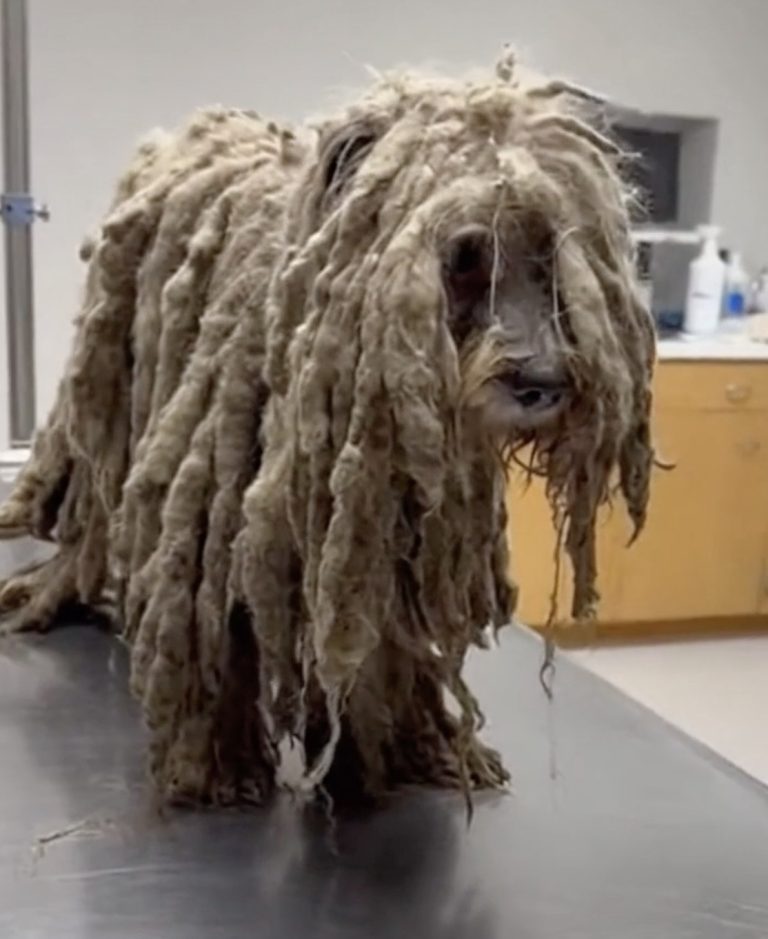
Sonador’s story is one that lingers in the heart long after you hear it. For years, he lived shut away in a cramped, forgotten shed, hidden from the world and deprived of even the most basic care. There was no comfort there, no companionship, no gentle hand to brush his coat or reassure him that he mattered. Isolation became his entire existence. Day after day, season after season, he remained locked in that small space, his world reduced to four confining walls.
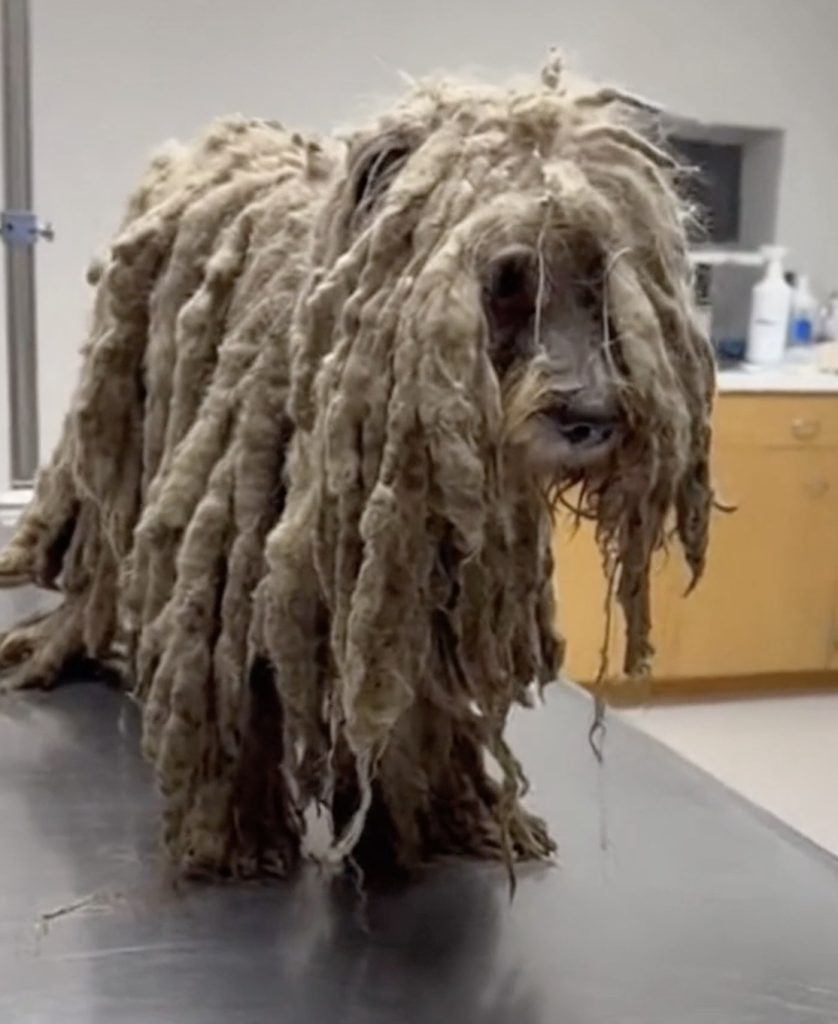
Without proper grooming or attention, his fur grew unchecked. Over time, it twisted and knotted into thick, hardened mats that wrapped around his body like heavy armor. The weight of it pressed against his skin and restricted his movement so severely that he could barely function. What should have been a soft, protective coat became a burden that almost immobilized him. It is difficult to imagine how uncomfortable, even painful, that must have been. Neglect does not always shout; sometimes it shows itself quietly, in the slow accumulation of suffering that no one stops to notice.
When rescuers finally discovered Sonador, the sight before them was deeply distressing. His condition spoke of years without care or kindness. The severity of his neglect was so evident that authorities were contacted to ensure the situation would be addressed appropriately. No living being should endure such prolonged disregard. Accountability matters, not out of vengeance, but because compassion must be defended. When cruelty or neglect is confronted, it sends a message that vulnerable lives have value.
Yet amid everything he had endured, what stood out most about Sonador was not anger or fear, but gentleness. Despite years of isolation, he did not lash out at the humans who approached him. There was no aggression in his eyes when rescuers knelt beside him. Instead, there was a quiet softness, as though some small ember of trust had survived against all odds. For many who work in rescue, this is the part that breaks them open: the realization that even after profound neglect, a dog can still choose trust over hostility.
However, isolation leaves its mark in complicated ways. While Sonador remained calm with people, he reacted strongly around other dogs. Years without healthy social interaction had shaped his behavior. What might have been natural canine communication was replaced by reactivity and defensiveness. It was not malice; it was the echo of loneliness. When a dog grows up cut off from its own kind, it loses the chance to learn balance and confidence. Rehabilitation would require patience, consistency, and understanding.
Once the situation was cleared by authorities, Sonador was transported to a veterinary clinic where the most immediate need could finally be addressed: removing the suffocating mass of fur that covered him. The grooming session was not simply cosmetic. It was medical, necessary, and transformative. As clippers carefully worked through the thick layers, pounds of tangled hair fell away. With every pass, more of Sonador emerged. Beneath the heavy coat was a dog no one had truly seen in years.
When the last of the mats were removed, the change was astonishing. What had looked like a defeated, burdened animal was revealed to be a beautiful dog with bright eyes and surprising energy. His body, once constrained, could finally move freely. He stood taller. He walked more easily. It was as though a physical and symbolic prison had been lifted from him at the same time. Grooming may seem simple, but in this case, it restored dignity.
Recovery does not happen overnight. Sonador began a carefully planned, high-protein diet designed to rebuild his strength and restore his health. Years of neglect had taken a toll, and nourishment would play a central role in his healing. Proper food, clean water, veterinary care, and a safe environment became the foundation of his new life. Step by step, he started regaining muscle and stamina. His coat would grow back, but this time it would be maintained with care.
Beyond the physical transformation, something deeper began to unfold. In a safe space where he was spoken to gently and treated with respect, Sonador started learning what freedom felt like. He could stretch out without restriction. He could explore without fear of being shut away again. For a dog who had known only confinement, even simple pleasures became extraordinary. A comfortable bed. Fresh air. The steady presence of people who cared.
For those in their later years who have witnessed both hardship and resilience, Sonador’s story carries a familiar truth. Life can be unfair. It can confine us in ways we never anticipated. But it can also change, sometimes because someone chooses to step in and help. Compassion, when acted upon, becomes a powerful force.
Sonador is now on a path toward full recovery. Behavioral work will help him adjust to other dogs. Continued medical care will ensure his health remains stable. Most importantly, he is no longer invisible. He is no longer trapped in a shed, hidden from the world. He is seen. He is valued. He is given the opportunity to live the life he always deserved.
His journey reminds us that rescue is not just about saving a body; it is about restoring hope. It is about recognizing that even after years of neglect, a gentle spirit can endure. And sometimes, all it takes to unlock that spirit is the courage to open a door that should never have been closed in the first place.
