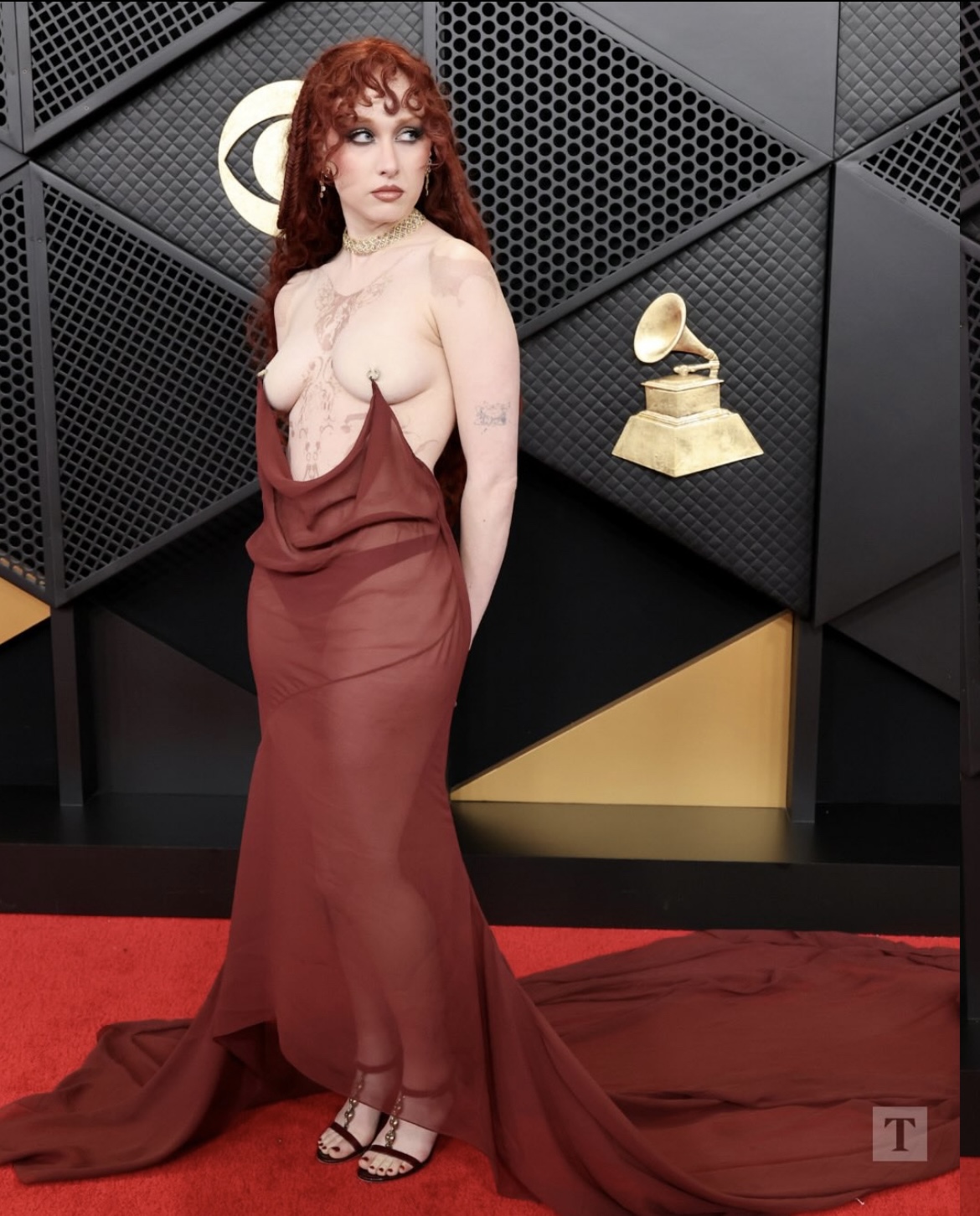
On the night the Grammys turned Los Angeles into a cathedral of spotlights and secrets, she stepped out of the black SUV like a rumor made flesh.
The dress was Mugler, burgundy so deep it drank the light around it. Sheer tulle fell in liquid waves from her collarbones to the carpet, held up by nothing more than two tiny gold rings at the shoulders and the sheer force of her refusal to apologize. The bodice was illusion—bare skin painted with temporary black lace tattoos that crawled like ivy across her chest and ribs: a tiny pony galloping over her heart, gothic flourishes blooming down her sternum, a quiet map of everything she had once been told to hide.
Her hair was fire. Long, Pre-Raphaelite curls the exact color of rust and revolution spilled past her waist, catching every flash so that for a second the photographers thought the carpet itself had caught flame.
She did not smile the way people are supposed to smile on red carpets—tight, grateful, contained. She tilted her head, eyes half-lidded and amused, lips the color of fresh blood, and looked directly into the lenses like she was daring them to blink first. The pose was deliberate: one hip cocked, one hand resting lightly on the curve of her waist, the other dangling a crystal clutch the size of a matchbox. Every inch of her said, I know exactly what you’re thinking. And I’m still walking.
Behind her the giant gold gramophone trophy gleamed like a forgotten Oscar Wilde prop. Around her, security shifted uncomfortably. A few older reporters whispered “controversial.” Younger ones were already live-tweeting single words: Icon. Unhinged. Mother.
She had spent the morning in a hotel suite arguing with her stylist about whether the sheer panels were “too much.” The stylist had lost. Chappell had won by saying only four words: “If it’s too much, it’s exactly right.”
When the wind caught the long train and lifted it like a cape, she did not flinch. She let it billow. Let the cameras drink in the negative space where fabric should have been. Let the world see the freckles on her shoulders, the small crescent-moon scar above her left breast, the way her ribcage rose and fell without shame.
Because this was not a gown.
This was armor made of audacity.
This was the opposite of apology.
Later, inside the arena, she would lose the award she was nominated for. She would clap politely for the winner, blow a kiss to the camera, and disappear backstage to change into something even more ridiculous for the after-party.
But on that carpet, for those sixty seconds between the velvet rope and the entrance, she was untouchable.
Not because no one could touch her.
But because she had already decided that anyone who tried would have to burn first.
And the city—shivering under a February sky that refused to rain—watched her walk away trailing crimson light like comet dust, already writing the myth she would become tomorrow

About the Author